Best when
- Use this when learning from real-world service experiences firsthand.
- Use this when teams rely on second-hand reports only.
- Use this when experience issues are context-dependent.
- Use this when you need empathy and evidence quickly.
Method
A field observation method where teams experience or observe the service in context, capturing friction, workarounds, and emotional moments.
Choose this if
This method works when learning from real-world service experiences firsthand.
Pack = one session you can run now. Workspace = a saved thread for method choice, planning, and shareable outputs.
What Workspace helps you carry forward
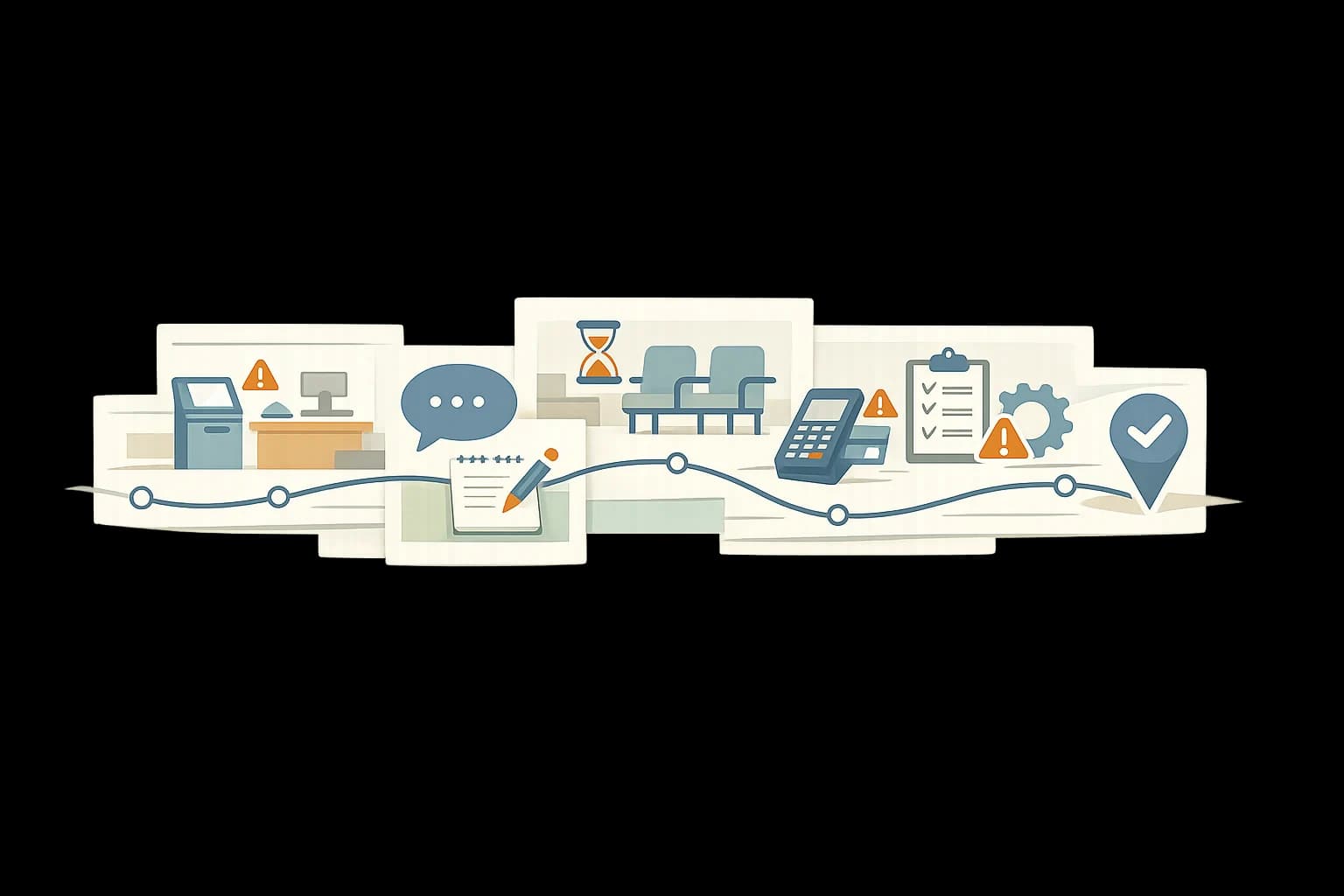
Artifact preview
Observation notes
Understand needs · High
Decide fit before you spend session time.
Room fit check
Best when second-hand accounts are no longer enough and the team needs firsthand evidence of how the service actually behaves in context. This room can still use the method, but only if you tighten the setup around the main risk.
Primary risk: The observation turns into a guided tour, so the team sees the service as staff want it seen.
The core facilitation flow, with enough structure to run the method confidently in the room.
Standard setup for Mixed in in-person delivery.
Total planned time: 240 min
What happens
Set locations, scenarios, and capture focus.
Facilitator does
Set the specific service context, role, and time window for observation before the field visit. Agree what participants should document: verbal interactions, environmental cues, moments of friction, workarounds. If team members disagree on what counts as relevant, resolve it here — not in the field.
Participants do
Name the specific service context, touchpoint, or staff-customer interaction you will observe — not "customer service in general" but "the counter interaction at the point of complaint escalation." The more specific the focus, the more consistent and comparable the observation data across the team.
Output / signal of success
The group is aligned on the exact challenge, actor, or scope the rest of the method will serve.
Watch for
Observation scope is too broad and observers capture inconsistently useful data.
Recovery tip
If team members are disagreeing about what to focus on in the field, it means the hypothesis behind the safari hasn't been agreed. Stop and ask: "What is the one thing we most need to understand by the end of this visit?" That answer should drive the observation scope — everything else is secondary.
What happens
Observe behaviors and service interactions.
Facilitator does
Observe without intervening unless a service failure is ongoing and you can help without distorting the observation. Take time-stamped notes and capture artefacts where ethics and consent allow. The debrief must happen immediately after the field visit, not a day later.
Participants do
Record what you see and hear, not what you infer about why. Write observations as specific moments — "the customer read the form three times and then asked staff which field to use" — not as conclusions — "the form was confusing." The interpretation happens in the debrief, not in the field.
Output / signal of success
Contextual insight themes
Watch for
Observers make assumptions about user intent without staying close to observable behavior.
Recovery tip
For observers who begin inferring user intent rather than recording observable behavior, review their notes and ask for each inference: "What specifically did you see or hear that led to this interpretation?" Write the observable behavior. The inference may be correct — but observations and interpretations must be kept separate until the debrief.
What happens
Synthesize observations into themes.
Facilitator does
Run the debrief within thirty minutes of returning. Each observer shares three specific observations — one surprising, one confirming, one contradicting — before any synthesis begins. Cluster across observers rather than combining one observer's notes. Cross-observer convergence is your strongest signal.
Participants do
Each observer shares three specific observations before any synthesis begins: one that surprised you, one that confirmed something you suspected, and one that contradicted something. Structure the share this way — it prevents the debrief from becoming a summary of highlights and surfaces the contradictions that are most generative.
Output / signal of success
Natural patterns are forming without long arguments, and the room can point to why items belong together.
Watch for
Debrief becomes a storytelling session rather than a structured synthesis exercise.
Recovery tip
If the debrief is becoming a storytelling session rather than structured synthesis, call a pause. Ask each observer to write their top three observations on separate stickies before speaking. Post them all at once, then cluster across observers. Cross-observer convergence is your strongest signal.
What happens
Identify priority improvements.
Facilitator does
For each cluster, write the underlying unmet need or gap: 'customers currently struggle to...' or 'staff currently work around...' Connect each opportunity to the specific observation that anchors it. Opportunities without a named evidence base are hypotheses from before the safari, not findings from it.
Participants do
Write each opportunity as a user or staff need: "customers currently struggle to..." or "staff currently work around..." Then name the specific observation that anchors it. If you can't name the observation, it may be an assumption you held before the safari — label it as such and don't blend it with the field data.
Output / signal of success
Observation notes
Watch for
Opportunities are stated as solutions rather than as user or staff needs.
Recovery tip
For any opportunity written as a solution ("redesign the intake form"), ask: "What does the staff member or customer currently struggle with that makes this solution relevant?" Write the struggle as the opportunity. "Staff re-enter customer details because the intake form doesn't pre-populate from the CRM" is an opportunity. "Redesign the intake form" is a solution brief.
Prepare the room, the evidence, and the working surface so the session can stay focused on synthesis.
Access to a real service environment where the relevant staff-customer interaction can be observed without significant disruption or consent complications. If access requires complex consent processes or is logistically constrained, plan for a shorter, more focused observation window rather than attempting a longer observation that risks access being revoked.
Observation plan
Optional
Consent guidance
Optional
Operational context note
Optional
Bring examples, pain points, or service evidence the room can point to quickly.
Debrief board
Optional
Room choreography
Required
Decide where to cluster, vote, and close out ownership before the room fills.
Capture template
Required
Debrief board
Required
Wall space, markers, and visible voting materials
Required
Make the working surface legible from across the room.
Observation capture sheet
Keep the output usable, then use the recovery guidance when the room starts drifting.
What this does not produce
Service Safari produces direct observation evidence from a specific service context at a specific time. It does not produce a representative picture of the whole service — a single visit captures the service on that day, in that location, with those staff. Patterns require multiple observation sessions to establish. Single-session findings are hypotheses worth investigating further.
Failure mode
Why it happens
Field observation is time-intensive and teams often conduct a single visit. One service interaction can be memorable and vivid — especially if something goes wrong — and that single observation can anchor the entire synthesis. The finding feels concrete because it was directly observed, but it may be an exception rather than a pattern.
Recover now
If this happens, in the debrief, mark each observation as either "single signal" (observed once) or "convergent signal" (observed multiple times or corroborated across observers). Design recommendations based on single signals should be flagged as hypotheses requiring additional evidence before action.
Prevent next time
Next time, plan for multiple observation sessions — at minimum 2–3 visits at different times or under different conditions. If only one visit is possible, build the limitation explicitly into the brief and treat all findings as hypothesis, not evidence.
Failure mode
Why it happens
Field teams often return to the office intending to debrief but get pulled into other work. When the debrief finally happens — a day or two later — the specific behavioral details, the exact quotes, and the contextual nuance have been replaced by summarised impressions. The synthesis loses its specificity and the most valuable micro-observations are gone.
Recover now
If this happens, if the debrief has already been delayed, ask each observer to return to their raw notes and identify the three most specific behavioral observations they recorded. Use those as the anchor for synthesis rather than recalled impressions.
Prevent next time
Next time, schedule the debrief as a hard commitment immediately after the field visit — ideally within 30 minutes of returning, certainly within the same day. Make it a non-negotiable part of the observation protocol, not an optional follow-up.
Failure mode
Why it happens
Observers arrive with existing hypotheses about what causes service failures. During observation, they selectively notice evidence that confirms those hypotheses and unconsciously interpret ambiguous behaviors through that lens. The observation notes read as evidence for the team's prior beliefs rather than as a fresh account of what happened.
Recover now
If this happens, in the debrief, ask each observer to separate their observation notes into two columns: "what I saw or heard" and "what I think it means." Review the first column as the evidence base. Use the second column as hypotheses to be examined rather than conclusions already reached.
Prevent next time
Next time, brief observers before the field visit: "Your job is to record what happens, not to explain it. Any interpretation belongs in a separate column or a note. The debrief is where we make meaning — the field is where we collect raw material."
Change the shape of the session only after the fit and runbook are clear.
Standard variant for Mixed in in-person delivery. Waypoint is adapting timing, facilitation emphasis, prep, and recovery guidance here, but the room still needs final tailoring to the exact stakes and participants.
Use this after you have checked the fit and know you want to carry the method forward.
The pack is the fastest way to run this now. Use the links below when you need prep, sharing, or a saved reference point.
Guides
The book strengthens service-safari work by giving observers a clearer standard for what to notice in context: broken continuity, hidden dead ends, weak assistance, and the operational conditions that make a service stop working as one service.
Open this when you want stronger rationale before choosing the method or taking it into the workspace.
A practical argument that a service only works when the whole system around a user's goal works, not just the touchpoint the organisation happens to own.
Sources and references used in this method page.
Service design observation method reference.
Foundational interview and qualitative research guidance.
Reviewed 2026-02-27 by Discovery Waypoint Editorial Team
Related playbooks
These pages translate recognizable external methods into Waypoint-native guidance so the team can borrow the useful part without importing the whole mythology.