Best when
- Use this when turning messy notes into clear themes.
- Use this when after interviews, shadowing, or diary studies.
- Use this when teams disagree on what evidence means.
- Use this when before building personas or journey maps.
Method
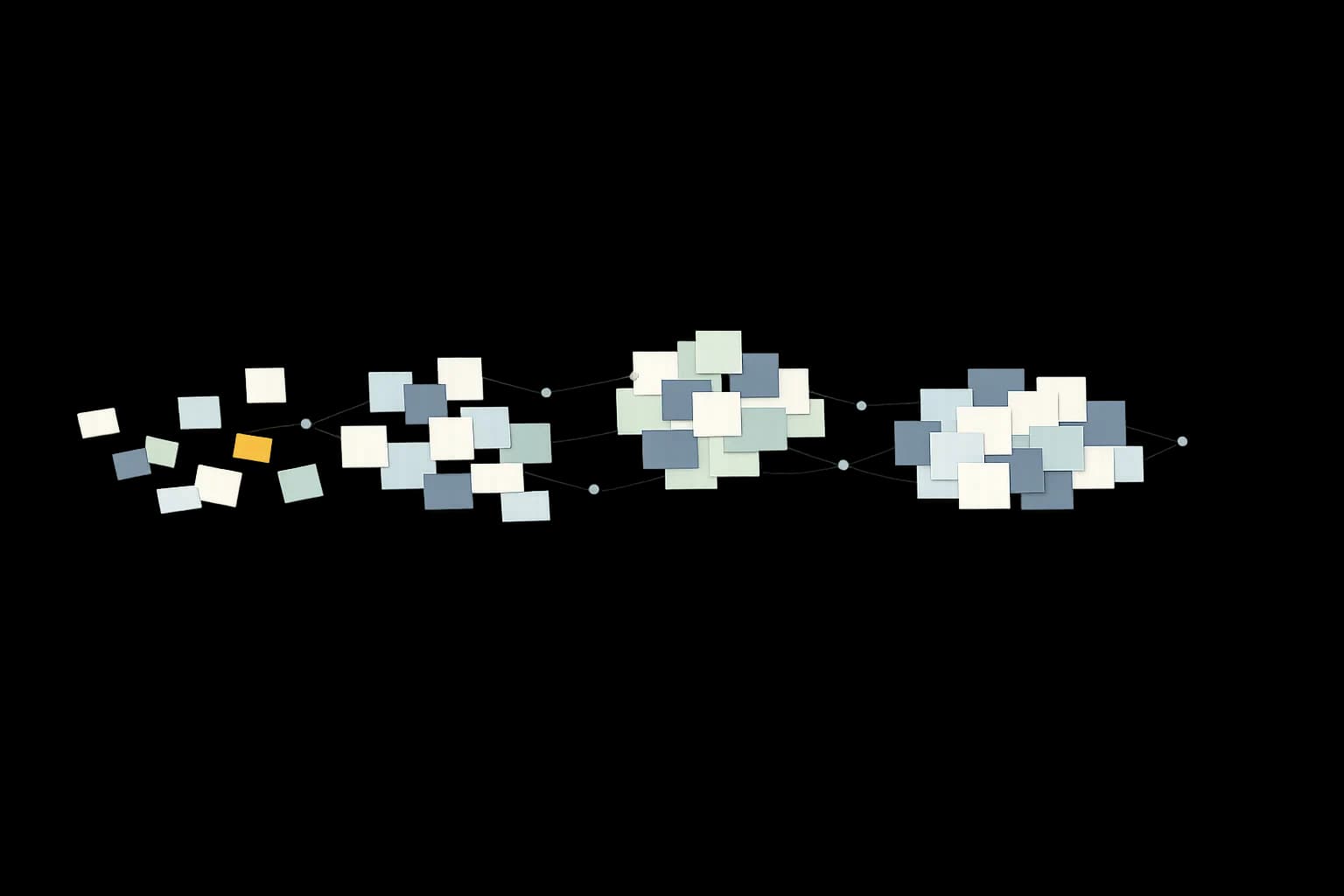
A synthesis method where teams cluster observations into themes and patterns.

Artifact preview
Insight themes
Understand needs · Low
Decide fit before you spend session time.
The core facilitation flow, with enough structure to run the method confidently in the room.
Standard variant for Mixed in remote delivery. Waypoint is adapting timing, facilitation emphasis, prep, and recovery guidance here, but the room still needs final tailoring to the exact stakes and participants.
Total planned time: 75 min
What happens
Write one observation or quote per note.
Facilitator does
Keep inputs atomic and legible. Stop the room if people bring paragraphs, blended ideas, or early interpretation before the base material is visible.
Participants do
Turn raw quotes or observations into one-note evidence fragments so the room is sorting signals, not debating source documents.
Output / signal of success
The room has a clean set of short, specific inputs that can be moved, compared, or evaluated quickly.
Watch for
Jumping to solutions during synthesis.
Recovery tip
If inputs are muddy, pause and rewrite them into one clear note, assumption, actor, or observation before moving on.
What happens
Group related notes without naming categories first.
Facilitator does
Protect silent sorting early, then intervene only to clarify patterns. Bring the room back to source material if clustering drifts into advocacy or solutioning.
Participants do
Move notes silently first, then explain only the clusters that need clarification so patterns emerge before opinions take over.
Output / signal of success
Natural patterns are forming without long arguments, and the room can point to why items belong together.
Watch for
Jumping to solutions during synthesis.
Recovery tip
If the room gets argumentative, reset into silent moves for two minutes and regroup from the visible material.
What happens
Name clusters with user-centered insight headlines.
Facilitator does
Push for sharp working language. Rewrite anything that sounds vague, internal, or too broad to guide the next decision.
Participants do
Name each cluster as a user truth or behavioral pattern, not an internal category label.
Output / signal of success
Each cluster has a working headline that sounds like an insight, theme, or decision-worthy pattern rather than a filing category.
Watch for
Jumping to solutions during synthesis.
Recovery tip
If labels stay vague, ask what the evidence actually says people are doing, needing, or reacting to.
What happens
Vote on themes with highest user and business impact.
Facilitator does
Push for sharp working language. Rewrite anything that sounds vague, internal, or too broad to guide the next decision.
Participants do
Name each cluster as a user truth or behavioral pattern, not an internal category label.
Output / signal of success
Each cluster has a working headline that sounds like an insight, theme, or decision-worthy pattern rather than a filing category.
Watch for
Jumping to solutions during synthesis.
Recovery tip
If labels stay vague, ask what the evidence actually says people are doing, needing, or reacting to.
Tune the method to the room without changing the core synthesis move.
Standard variant for Mixed in remote delivery. Waypoint is adapting timing, facilitation emphasis, prep, and recovery guidance here, but the room still needs final tailoring to the exact stakes and participants.
Prepare the room, the evidence, and the working surface so the session can stay focused on synthesis.
Standard variant for Mixed in remote delivery. Waypoint is adapting timing, facilitation emphasis, prep, and recovery guidance here, but the room still needs final tailoring to the exact stakes and participants.
Interview notes
Optional
Quotes and observations
Optional
Digital or physical wall
Optional
Color coding for themes
Optional
Operational context note
Optional
Bring examples, pain points, or service evidence the room can point to quickly.
Remote facilitation choreography
Required
Pre-plan handoffs, breakout usage, and how people rejoin the main board.
Shared digital board with timer and voting
Required
Keep instructions and voting visible at all times.
Affinity board
Use this to judge whether the session produced something clear enough to act on tomorrow.
Read these like live facilitation coaching, not a reference table.
Standard variant for Mixed in remote delivery. Waypoint is adapting timing, facilitation emphasis, prep, and recovery guidance here, but the room still needs final tailoring to the exact stakes and participants.
Failure mode
Why it happens
Common facilitation blind spot.
Recover now
If this happens, pause, restate objective, and re-anchor the group.
Prevent next time
Next time, use participant quotes to anchor themes.
Failure mode
Why it happens
Common facilitation blind spot.
Recover now
If this happens, pause, restate objective, and re-anchor the group.
Prevent next time
Next time, name themes as user truths, not internal opinions.
Failure mode
Why it happens
Facilitation cues and visual state changes are not made explicit enough online.
Recover now
If this happens, pause, restate the current decision point, and narrate exactly what changed on the shared board before moving on.
Prevent next time
Next time, assign one visible working board, one timer, and one facilitator voice for transitions.
Use this only after you understand the flow and have checked the method fits the room.
Open the facilitator pack when you need a one-session version you can run now. Move into Workspace when this method needs broader coordination, decision tracking, or follow-through.
Sources and references used in this recipe.
Nielsen Norman Group synthesis methods.
Foundational interview and qualitative research guidance.
Reviewed 2026-02-27 by Discovery Waypoint Editorial Team